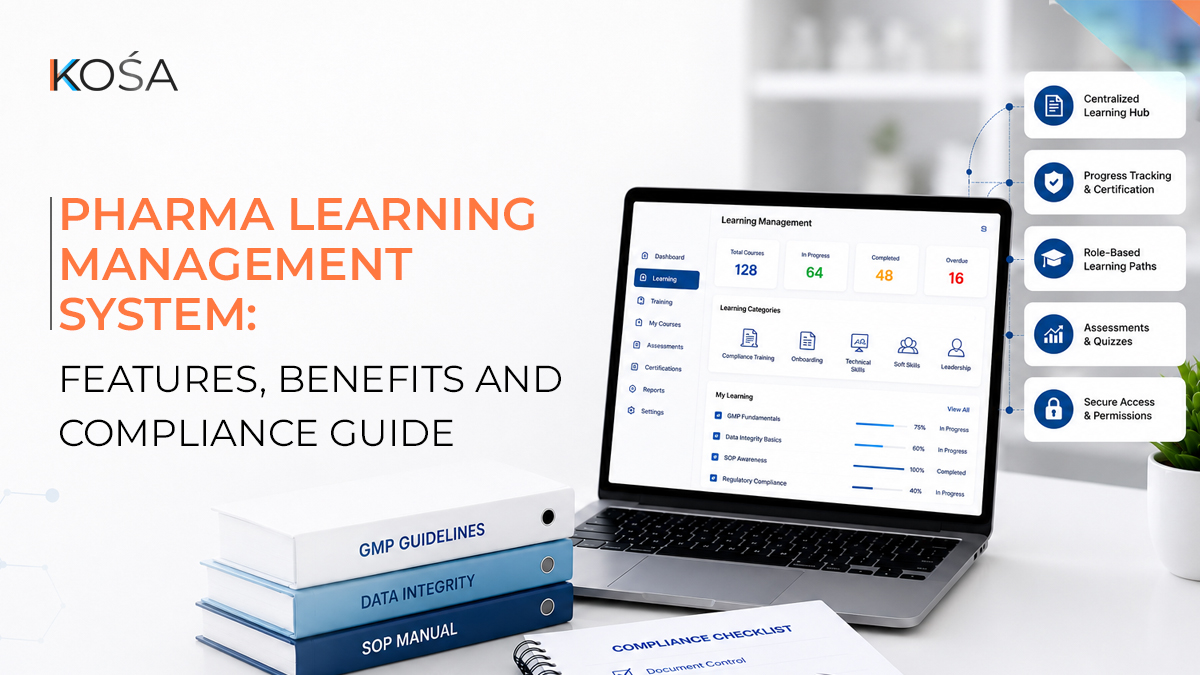
Maintaining an educated pharmaceutical workforce becomes hard as SOPs change every few months and inspectors demand evidence, not just empty promises. Plenty of companies still resort to using spreadsheets, e-mails, and pen-and-paper sign-offs and as a result, their employees get educated by using the old version of the SOP, qualifications expire, and training evidence lacks whenever an inspector asks for it. A pharma learning management system closes exactly that gap, giving companies one place to assign, deliver, track, and document regulated training. This guide covers what a pharmaceutical learning management system actually does, essential features, GMP and GxP training, SOP retraining, compliance requirements, and how to choose and implement one, without getting lost in the search for the right LMS for pharmaceutical industry use.
What Is a Learning Management System in Pharma?
The pharma learning management system is a web-based platform that pharmaceutical companies use to assign, deliver, track, assess, and maintain compliance documentation of employee training.
That’s the textbook version. In practice, a learning management system in pharma is about a much narrower question: can you prove, months later, that the right person read the right procedure and actually understood it?
A pharma LMS supports GMP and GxP training, SOP read and understand activities, online learning, classroom sessions, on-the-job training, assessments, certification tracking, refresher training, and qualification records, all tied back to a real employee and a real document version. In pharma, the meaning of LMS goes well beyond just hosting videos. Training has to connect to employee roles, approved procedures, and evidence of competence, or it’s just content nobody can actually defend during an inspection.
For a closer look at how role-based curricula, SOP linkage and inspection-ready records work together, see this learning management system for pharmaceutical training
Why Pharmaceutical Companies Need a Specialized LMS ?
A general corporate LMS is built for the kind of compliance training where clicking through a few slides and passing a quiz is basically the finish line, think data privacy or workplace conduct courses. Pharma manufacturing doesn’t work that way. Every role needs different training, SOPs get revised constantly, GMP training never really ends, and most companies run more than one facility with local requirements layered on top of the global ones.
Qualifications expire quietly if nobody’s watching, and plenty of skills genuinely need to be demonstrated on the floor rather than just read about on a screen.
Finishing a course isn’t proof of much on its own. Pharmaceutical companies often need to show who was trained, which document or course version they trained on, when it happened, whether they passed the assessment, whether a supervisor actually verified the practical skill, and whether retraining was ever completed.
FDA regulations require relevant drug manufacturing personnel to have suitable education, training, and experience, including continuing training in current Good Manufacturing Practice, and that vs. Exactly the bar LMS for pharmaceutical industry platforms are built to clear, unlike pharmaceutical compliance training bolted onto a generic HR tool.
General LMS vs Pharma Learning Management System
Among the many types of learning management systems on the market, a general LMS and a pharma learning management system can look similar at first, since both deliver courses and track who finishes them. The difference shows up the moment a regulator asks for proof rather than a completion percentage.
Area | General LMS | Pharma LMS |
Primary purpose | General employee development | Regulated pharmaceutical training |
Training assignment | Team- or department-based | Role, site, SOP and qualification-based |
SOP connection | Usually limited | Connected with controlled SOPs |
Retraining | Often assigned manually | Can be triggered after SOP revisions |
Training evidence | Basic completion records | Traceable and audit-ready records |
Practical training | Often limited | Supports OJT and supervisor approval |
Compliance support | General controls | Supports GMP, GxP and electronic record needs |
Software alone doesn’t guarantee compliance, no matter how many rows in that table it checks off. That still depends on intended use, correct configuration, system validation, internal procedures, access controls, and record retention practices. A tool can be technically capable of everything above and still fail an inspection if it’s configured wrong, which is really where a compliance training LMS earns its name, and why the strongest platforms are built as a 21 CFR Part 11 compliant LMS from day one rather than retrofitted afterward.
How a Pharma LMS Supports GMP and GxP Training
1. Role-Based Learning
Learning that does not take into account what the individual does every day will be of little benefit. The pharma LMS schedules learning according to the employee’s job function, department, location, equipment type, product line, and personal responsibility so that the reading lists of the production operator and quality assurance staff never overlap. For instance, the production operator normally requires GMP fundamentals, data integrity basics, the specific SOP for the operator’s line, and equipment-related on-the-job training. A typical pharmaceutical quality assurance employee, on the other hand, requires CAPA, deviations management, documentation control, and audit preparedness training. Role-based learning makes such differences automatic rather than manual.
2. Recurring and Refresher Learning
Courses on GMPs are never attended only once. It must be able to automate the process of recurring GMP course completion, schedule due dates, notify about expiration ahead of time, track expiry of certification, and automatically reschedule refresher training when due.
3. Assessments and Qualification
Course completion, quiz scores, practical observation, trainer feedback, supervisor approval and electronic acknowledgement all need to feed into the same qualification record. There’s a real difference between someone attending a session, someone understanding the material, and someone actually demonstrating competence on the floor. A pharma LMS worth using should be able to tell those three things apart, not treat them as the same checkbox.
How SOP Changes Trigger Pharmaceutical Retraining
This scenario is really where a pharma learning management system earns its keep, because a training platform that isn’t connected to document control is only doing half the job. Here’s roughly how it plays out. An SOP gets revised inside the document management system, goes through review and approval, and the roles and employees affected by the change are identified.
Updated training gets assigned automatically. An employee reviews and acknowledges the revised SOP, passes the required assessment/practical test, and the supervisor signs off on his/her performance. An employee gets his qualification record updated, and the full history of his training remains accessible for the inspector at all times.
Skip that connection between document control and training, and employee retraining becomes something that happens whenever someone remembers rather than something change control actually enforces. Linking a pharmaceutical document management system with the training platform is what makes sure people are training on the current, effective version of a document, not something that got superseded three revisions ago, and the full history stays available for exactly the kind of inspection readiness regulators expect to see.
For more details on how document control and training connect, see this pharmaceutical document management guide or read more directly about a pharmaceutical document management system .
Essential Features of a Pharma Learning Management System
1. Role-Based Training Plans
Training should be assigned automatically according to employee roles, departments, sites and responsibilities, not handed out as one generic curriculum for everyone.
2. Training Matrix
The platform should show required training, completed courses, overdue assignments, missing qualifications, and upcoming renewals in a single view, a live training matrix rather than a spreadsheet updated once a quarter.
3. SOP Training Management
The LMS should connect controlled SOPs with the employees who need them and reassign training automatically whenever an approved document changes, functioning as real SOP training software rather than a passive file library.
4. On-the-Job Training
Practical skills get documented through observations, evidence, trainer comments, and supervisor approval, because reading about a task and demonstrating it are not the same thing.
5. Assessments and Pass Criteria
The system should support quizzes, minimum pass scores, repeat attempts, and effectiveness checks, so a passing grade actually reflects understanding.
6. Electronic Signatures
Employee acknowledgements and supervisor approvals need to be linked to verified user identities, not a shared login that half the shift has the password to.
7. Audit Trails
The system should maintain traceable records of assignments, completions, assessments, approvals and changes, producing audit-ready training records without anyone assembling them by hand beforehand.
8. Automated Reminders
Employees and managers should get alerts for upcoming, overdue and expiring training well before it quietly turns into a finding.
9. Compliance Dashboards
Managers should be able to view completion levels and training gaps by role, site or department at a glance.
10. System Integration
The LMS should connect with DMS, QMS, HR systems, identity management tools and reporting systems so training data doesn’t sit isolated from the rest of the quality management system.
Pharma LMS Compliance Considerations
1. Good Manufacturing Practice
Training helps employees actually understand the approved procedures, quality expectations, and responsibilities tied to their specific role, which is really the whole point of Good Manufacturing Practice in the first place, not just a phrase printed on a wall certificate.
2. GxP
GxP is an umbrella term covering regulated good practices, including Good Manufacturing Practice, Good Laboratory Practice, Good Clinical Practice, and Good Distribution Practice, and a pharma LMS needs to flex across whichever of these actually apply to a given role or site.
3. 21 CFR Part 11
This becomes relevant the moment regulated records and signatures are created or maintained electronically. Look for secure access controls, electronic signatures, time-stamped audit trails, record retention, data security, and system validation. Put carefully, the LMS should provide capabilities that support the organization’s 21 CFR Part 11 requirements, since no platform can promise compliance on a company’s behalf.
4. ALCOA+
Training records need to be attributable, legible, contemporaneous, original, accurate, complete, and available; the same ALCOA+ principles regulators apply to every other kind of GxP record, training included.
5. Scripted Testing as per FDA
CSA asks manufacturers to scale their documentation to the assurance approach actually used, rather than applying the same heavy paperwork everywhere. The table below covers the two scripted-testing approaches, where a written test plan exists before testing begins.
Assurance Activity | Test Plan | Test Results | Record |
Scripted Testing: Robust | Test objectives, step-by-step test cases, expected results, and plan reviewed/approved when appropriate | A result recorded for every case, with details on any failures | Intended use, risk-analysis outcome, detailed test report, per-case results, issues found and their resolution, tester and date, review sign-off |
Scripted Testing: Limited | A limited set of step-by-step cases with expected results, plus which unscripted methods covered the rest | A result recorded for every case, with details on any failures | Same as above, but with a summary rather than a detailed description of testing |
6. Unscripted Testing As Per FDA
The table continues into the three unscripted-testing approaches, where no formal script is written in advance, but the record still has to show what was tested and why it was judged acceptable.
Assurance Activity | Test Plan | Test Results | Record |
Scenario Testing | Features/functions tested against realistic use scenarios, no test plan | Details on any failures found | Intended use, risk-analysis outcome, summary of what was tested, issues found and resolution, tester and date, review sign-off |
Error Guessing | Likely failure modes tested, no test plan | Details on any failures found | Same as above, summarizing the failure modes tested |
Exploratory Testing | High-level objectives with pass/fail criteria, no step-by-step script | Details on any failures found | Same as above, summarizing the objectives tested |
Refer to the FDA guidelines for detailed guidance on Computer Software Assurance (CSA).
7. WHO Good Manufacturing Practice Guidelines
For companies manufacturing or supplying medicines outside the US, or pursuing WHO prequalification for products sold into public health programmes, WHO’s GMP framework carries just as much weight as FDA’s. WHO’s “Good manufacturing practices for pharmaceutical products: main principles“ (TRS 986, Annex 2) sets out personnel expectations that read a lot like FDA’s own: staff need initial and continuing training specific to their duties, training has to be documented, and its effectiveness has to be periodically assessed rather than assumed after the fact. WHO’s supplementary guideline on validation (TRS 1019, Annex 3) extends the same expectation to computerized systems, requiring that staff operating validated systems, an LMS included, are trained on those systems before the systems are relied on for GMP decisions. A pharma LMS supporting multi-region or WHO-regulated operations should be able to map role-based training requirements against WHO expectations alongside FDA and EU ones, rather than forcing a quality team to run a separate, parallel process just for WHO-prequalified markets.
Benefits of a Learning Management System for Pharmaceutical Companies
1.Centralized Training Records
Training, assessments, acknowledgements, and qualifications all live in one place instead of scattered across shared drives and filing cabinets.
2. Faster Employee Onboarding
New hires get a structured learning plan based on their actual role from day one, instead of a generic packet.
3. Less Manual Administration
Automated assignments, reminders, and reports cut down the spreadsheet chasing that eats a training coordinator’s week, one of the more underrated benefits of a learning management system.
4. Better Compliance Visibility
Managers can spot overdue training and qualification gaps quickly, before they turn into an actual finding.
5. Improved Inspection Readiness
Searchable, organized training records get pulled up in minutes during an audit, and that kind of inspection readiness usually separates a smooth visit from a stressful one.
6. Consistent Multi-Site Training
Core curricula stay standardized across sites while still leaving room for site-specific requirements.
7. Better SOP Change Management
Affected employees get identified and retrained automatically whenever a procedure changes, closing a gap that used to depend on memory.
How to Implement a Pharma LMS
Implementation tends to follow a fairly predictable path: identify regulatory and operational training requirements, map employees, roles, departments, and facilities, review and clean up the existing training matrix, organize current SOPs and training materials, define assignment, assessment, and approval workflows, configure deadlines and refresher frequencies, migrate historical training records, test electronic signatures and reports, validate the system according to its intended use, train administrators and employees, and monitor completion rates once it’s live.
Treat pharma LMS implementation as a compliance project, not a software installation handed off entirely to IT. LMS validation deserves its own dedicated timeline, and rushing it tends to show up later as regulatory compliance training gaps nobody notices until an inspector does.
How to Choose the Right Pharma Learning Management System
Before signing anything, run through a straightforward checklist. Is the LMS actually designed for regulated industries or adapted from a general corporate tool? Can training be assigned by role, site and department, and can SOP revisions trigger retraining automatically? Does it support online, classroom, and on-the-job learning, and can supervisors verify practical competence rather than just checking a box?
Does it generate a clear training matrix, track overdue training and expiring qualifications, and support electronic signatures and audit trails? What validation assistance is available, and can reports be generated quickly during an inspection rather than over several days? Can it integrate with DMS, QMS and HR systems, support multiple sites, offer role-based access controls, and scale as the company grows?
Buyers should evaluate the whole training and compliance workflow, not just how polished the course player looks in a demo. A pharma learning management system that cannot honestly answer most of these questions is likely not ready for a regulated floor.
Explore KOSA’s pharmaceutical compliance products
Common Pharma Training Management Mistakes
A few mistakes show up again and again: managing training entirely through spreadsheets, assigning the same courses to every employee regardless of role, never connecting SOP updates to retraining, tracking completion without testing understanding, ignoring practical competency, letting people share user accounts, allowing qualifications to quietly expire, keeping DMS and LMS records completely separate, and only pulling reports together once an inspection gets announced. Maybe the biggest one of all is assuming that buying software is the same thing as being compliant.
A strong pharmaceutical LMS should help catch these problems early, closing gaps in regulatory compliance training before they ever become audit findings, not after the fact.
Conclusion
A pharma learning management system should do a lot more than host courses online. Done right, it connects employee roles, SOPs, GMP training, assessments, on-the-job learning, qualifications, electronic records and compliance reporting into one system that actually holds up under scrutiny. KOSA brings controlled documents and role-based training into the same compliance environment, connecting document and training workflows across a shared compliance framework.
See how KOSA can simplify pharmaceutical training, SOP retraining, and inspection-ready reporting.
Book a personalised demo →
Frequently Asked Questions
1. What is a pharma learning management system?
It’s a platform for managing regulated pharmaceutical training, assessments, SOP learning, employee qualifications, and training records, connecting each course back to a specific role, procedure, and piece of documented evidence.
2. How is a pharma LMS different from a regular LMS?
The differences show up in SOP integration, role-based assignments, audit trails, electronic signatures, verified practical qualification, and compliance reporting, features that a general compliance training LMS usually wasn’t built to handle.
3. What training can a pharmaceutical LMS manage?
GMP, GxP, SOP, data integrity, quality assurance, laboratory, safety, onboarding, and product-specific training can all run through the same platform, rather than being split across spreadsheets.
4. What is a training matrix in pharma?
It’s a map connecting required courses, SOPs and qualifications to job roles or individual employees, showing at a glance who’s trained, who isn’t, and what’s coming due next.
5. Can a pharma LMS manage SOP retraining
Yes. Revised SOPs can be reassigned automatically to affected employees, along with acknowledgement, assessment, and supervisor approval requirements, as part of the change itself.
6. What is a 21 CFR Part 11 compliant LMS?
Generally, it refers to an LMS with controls supporting secure electronic records, signatures, audit trails, user access and validation, built to align with FDA expectations for electronic recordkeeping.
7. How does an LMS support inspection readiness?
Centralised, traceable records mean compliance teams can pull training evidence in minutes rather than days, which matters most exactly when an inspector is standing there waiting.